
PUC’s Online A.S. to B.S. Emergency Management Degree: Accessible and Asynchronous
By Marina Maher on November 20, 2026
Share this
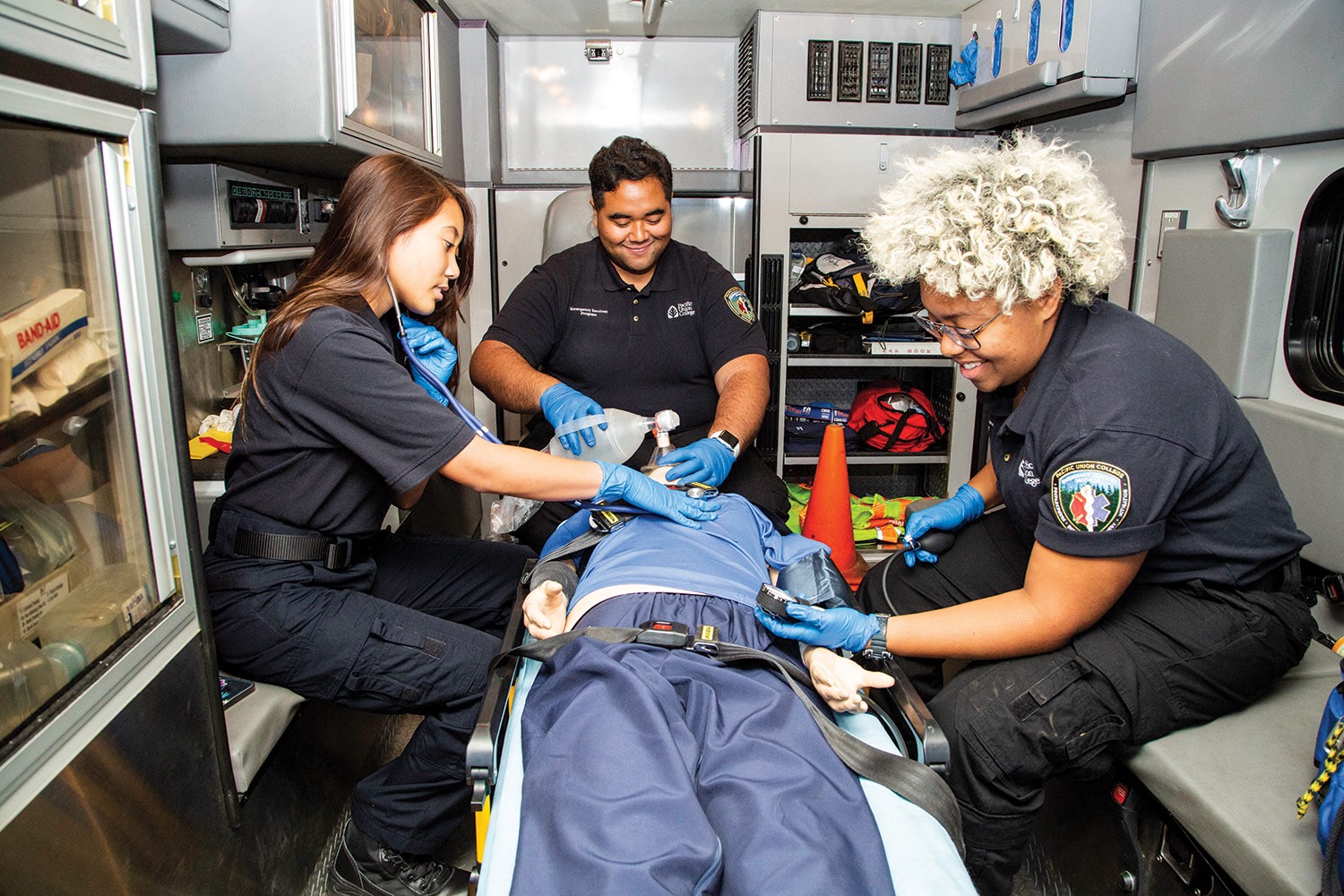
For about 10 years, Pacific Union College has proudly offered the Emergency Services Program and has continued to expand its offerings to meet today’s job market needs. Now, the A.S. to B.S. program is offered 100% online in California and Hawaii at a low cost, allowing students to enter with an associate's degree in Emergency Management from PUC or a related discipline from another institution. At a competitive price of $385 per credit unit, this program was designed to make the degree accessible, achievable, and convenient for working individuals, with practicums also available at nearby locations.
Recently, the program added three new courses, Foundations of Homeland Security, Technology in Emergency Management, and Continuity of Operations, to meet the needs of the emergency services field. Students with an A.S. in Public Safety, Law Enforcement, Criminal Justice, Emergency Services, Fire Science, Business, Psychology, Health Sciences, or a closely related field can easily adjust to this program’s asynchronous, 11-week term pace. With a three-hour-per-week average (per credit unit) that will be spent on coursework, students can pursue their education alongside their personal lives and careers.
With PUC leading in the medical and emergency services sector, students who graduate from this program have gone into fields like the Federal Emergency Management Agency (FEMA); the U.S. Army; the U.S. Navy; Amazon as a Workplace Health & Safety Specialist; Facebook as a Director of Global Security Emergency Services; the Georgia Department of Health as an Epidemiologic Investigator; Tesla as an Emergency Management Specialist; and in many counties and police departments across the country.
“With the new online option, students from outside PUC who have completed an associate's degree can now complete the B.S. in Emergency Management entirely online,” said Jeff Joiner, associate professor and director of the emergency services program. “We have designed this option for working adults who are already in the broad fields of emergency services, healthcare, public safety, and other related fields, who wish to enter emergency management or just need to further their education for career advancement. Courses are designed in an asynchronous format to allow flexibility for working adults and mirror the on-campus offerings. Depending on transfer credits and how many courses students take each quarter, they should be able to finish the bachelor’s degree in two to four years. Students can control how fast they progress.”
Ehren Terwey, a student in the program, is a paramedic based in California. He described the program as accessible because it isn’t commonly offered in most parts of the state, let alone in the country. "I think it provides a curriculum that works well with professionals' work schedules, which makes it much more achievable than in-person instruction," he said. "The content of the program itself is incredibly useful, and I find most of it to be pertinent in my line of work. It is presented well with an organized structure, which I appreciate, as well as the methods of instruction that I have experienced so far."
Because Terwey is based in the Bay Area, commuting to Angwin for classes would be difficult, so he described the online and asynchronous learning as "incredibly convenient" and said he wasn't sure he could pursue the degree without that option.
As a box medic (paramedic assigned to an ambulance), Terwey shared that the knowledge he gained throughout his courses has already proven effective in practice– an all-encompassing program that addresses factors of common disasters, how society can be better prepared, and the short- and long-term effects of certain disasters in specific populations.
"I never thought much about what happens after my 30 minutes of managing an exclusively medical emergency, and this program has taught me to consider both the other active components of emergency response and the long-term outcomes," Terwey shared. "I have gained a much larger understanding of how disasters and emergencies are typically handled initially, and the common quality improvement elements produced by analyses of previous disasters, which I can use to better perform in a response role."
"I would tell anyone considering the program that they should try out a couple of classes," said Terwey. "There is loads of information that I have learned so far that I get to use at work already. If you work anywhere near the fields of 911, government office, Search and Rescue (SAR), hazardous materials, or anything similar, I think this program would strengthen an understanding of how your role is connected to a larger orchestra."
Latest News
PUC’s Online A.S. to B.S. Emergency Management Degree: Accessible and Asynchronous
By Marina Maher on November 20, 2026
PUC’s Campus Ministries Revitalizes Student Missions
By Ally Romanes on November 19, 2026
Fall Week of Worship: Radiating the Love and Discipleship of Jesus
By Marina Maher on October 30, 2026
Society of Adventist Communicators Convention Recognizes PUC
By Ally Romanes on October 30, 2026