
Aviation Students Develop Motion Platform Software for Simulator Program
By Marina Maher on February 25, 2026
Share this
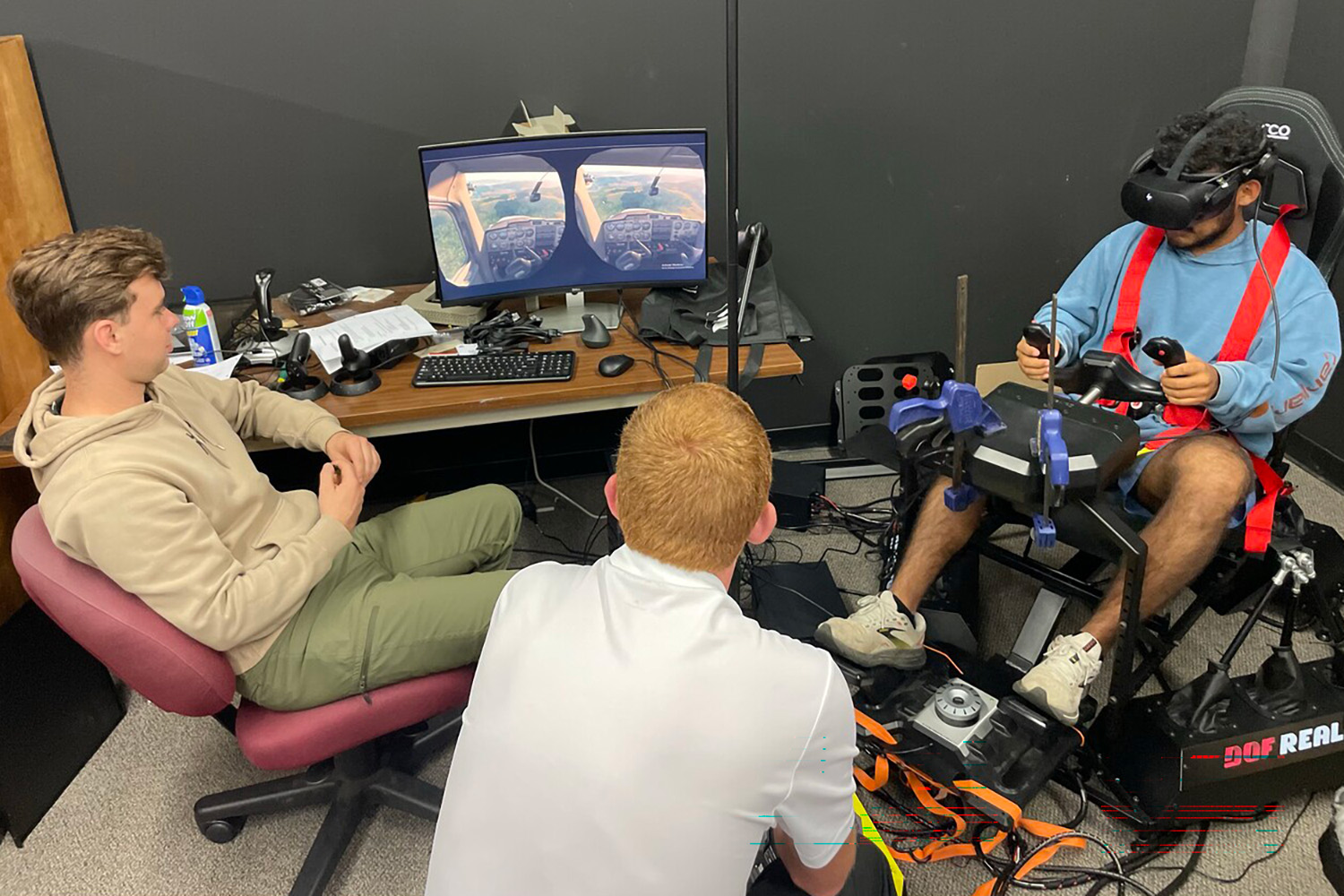
This past fall quarter, Pacific Union College Aviation Program Director Nathan Tasker taught the AVIA-402: Simulation Innovation course for the first time. The purpose of this class was to further the program’s two prototype simulators. One group focused on the full-motion, six-degrees-of-freedom platform purchased with funds from the 2025 VersaCare grant. This platform is a highly respected, cutting-edge device that is currently marketed for realistic, immersive simulation.
Throughout the quarter, aviation students have worked diligently and collaboratively to adapt this platform for use in a virtual reality full-motion trainer to help beginning flight students progress more rapidly and affordably. In the initial analysis of the program, the students attempted to validate the motion characteristics of the full-motion base. Students took measurements, made calculations, and analyzed the data to determine how well the platform simulated an aircraft hurtling through a large 3-D space, a complicated prospect. Unfortunately, they found that the original software did not accurately reflect washout and load factor, which are crucial factors for achieving a realistic result.
After they followed up with the manufacturer, the students learned that their goal was beyond the scope of the manufacturer's development team, prompting them to develop their very own motion platform software under the guidance of Randall Stephens, a ‘96 PUC alumnus with a Bachelor of Science in Electronics Engineering Technology.
“We faced many unexpected challenges, including breaking two actuator supports, but in the end, we were successfully able to drive the seat on an open-source program with only one missing link remaining,” Tasker said. Now, they can manually manipulate the seat in all three planes and axes; however, it still needs to be ported to the simulator so the flight dynamics program can control it. “We think we are close to having our software talk to the aircraft simulation program, and then we will be able to achieve our desired realism outcome.”
This is a major accomplishment that brings pride to the aviation program as a whole since this program-turned-reality will empower them to reduce dependency and costs associated with operating real aircraft.“We believe this software enhancement will be beneficial to everyone who owns this motion platform and other platforms produced by the same company,” Tasker passionately noted. “Our ultimate dream is to become contributors to this field, and perhaps one day we will build our own platforms, becoming producers of high-quality synthetic flight training technology so we can stand at the cutting edge of high-fidelity, affordable flight simulation.”
Latest News
Pacific Union College Announces Semester Conversion and Future Changes
By Marina Maher on October 23, 2026
PUC Partners with Maranatha for McReynolds Hall Renovation
By Marina Maher on October 22, 2026
PUC Hosts Girls’ Volleyball Tournament
By Ally Romanes on October 21, 2026
PUC’s 2026 Graduating Class Honors Allison Fox
By Ally Romanes on October 20, 2026