
Spring Week of Worship: Destined to be Healed at the Cross
By Marina Maher on May 15, 2026
Share this
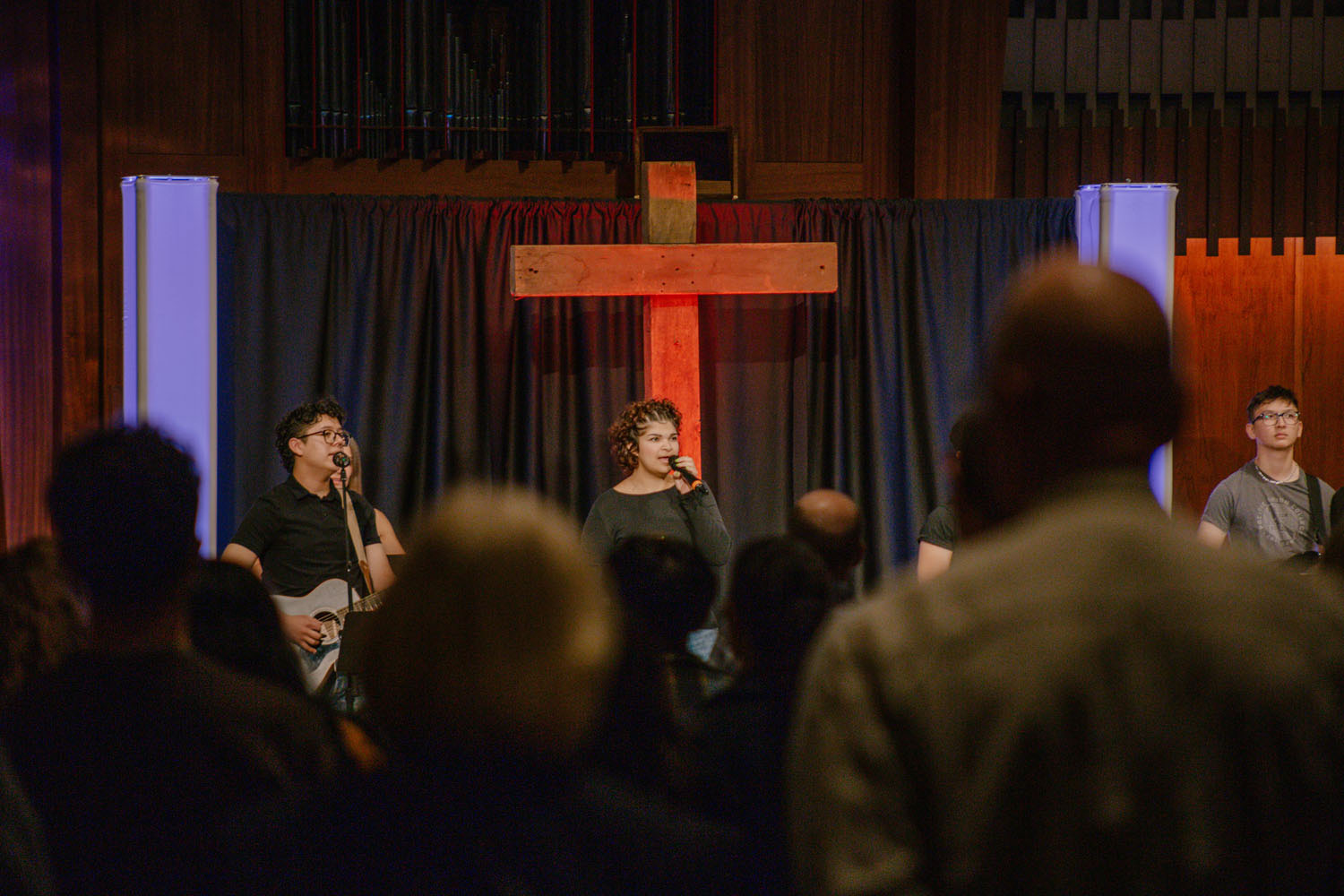
From April 13 to 17, Pacific Union College held its Spring Week of Worship service led by former Andrews University pastor, evangelist, and author Pastor Dwight Nelson.
He passionately started off the week by sharing his appreciation for the beauty across campus. “This [place] is just absolutely heavenly. I love this college, your president, your professors, and I am going to get to love you. I can tell just by looking at you.”
Kickstarting his sermon, he assured the audience that they are not alone if they feel deep hurt and don’t experience healing. “We are going to go to the cross five times together this week– Jesus says, 'Come to me, and I will give you rest.”
Holding a blank death certificate, Pastor Nelson directed the audience’s attention to the reality of being issued this piece of paper if Jesus doesn’t come soon enough. He told a story of a 22-year-old student who passed away in a car accident, someone who had her whole life ahead of her. Life is not certain, but it does have a purpose, pertaining to why Jesus died for all of humanity. He then asked, “What killed Jesus? Three Roman nails? How about the centurion’s lance that goes through the rib cage and into the heart that pierces it one last time?”
Pastor Nelson questioned listeners about Calvary and the “why” of human suffering: a tragic and barbaric pain paid by the divine price because “salvation for the chief of sinners was His theme,” according to Desire of Ages 753. He mentioned, if sinners were to perform the ancient ritual of sacrificing a yearling lamb every time their “favorite” sin was committed, “you and I might have to think twice about that favorite sin.”
Quoting Isaiah 53:6, Romans 6:23, 2 Corinthians 5:17 and 5:21, and John 1:29, Pastor Nelson explained through an excerpt in Ellen G. White’s Desire of Ages 753 that Jesus “feared that the sin was so offensive to God that Their separation was to be eternal.”
Pastor Nelson highlighted the writer of 1 Timothy 1:15, the Apostle Paul, who called himself “the worst sinner,” and then jumped to Luke 18, where the tax collector also called himself “the sinner,” exemplifying their need for God’s grace and mercy. They both humbled themselves before God, thus, according to Luke 19:14, were exalted.
He reflected on a private, pre-release showing of Mel Gibson’s The Passion of the Christ, where Gibson told the attendees that filming Jesus’s crucifixion felt personal and that it was his sin that sent Jesus to Calvary. Forgiveness, as Pastor Nelson explained it, was an outstretched arm of grace as Jesus hung on the cross, saying, “Father, forgive them for they know not what they do.”
Pastor Nelson then referred to King David’s story in 1 Kings 14:7, where David offered a heartfelt repentance and obedience to God even though he was not a sinless man. It was in this moment of true devotion to God that David composed and prayed over Psalm 51. In Steps to Christ 62, White said, “Christ’s character stands in place of your character, and you are accepted before God just as if you had not sinned,” aligning with Pastor Nelson's transcription of Jesus’s death as a cover for all, as well known to humans as grace.
Turning the audience’s attention to a photorealistic 19th-century painting of the crucifixion by Antonio Ciseri, he began to point out several details of the painting– from the lashes on Jesus’s back to the executioner standing beside him to the presence of Pontius Pilate. Pastor Nelson used the reference of the painting to introduce the seven threes found at the Cross in the Gospel of John: three “no fault” declarations, three titles, three languages, three Marys, three words, three actions, and three woundings.
“Jesus chooses the moment and the second of his death,” he said. “Now, when you and I die, if Jesus doesn’t come soon enough or if we don’t live long enough, our names will be on a death certificate– that’s life. When you and I die, we won’t choose a moment, but there will be a last breath.”
Using the imagery of a final breath of life, Pastor Nelson expressed that because of Jesus’s sacrifice for humanity, followers would be able to be with Him in paradise. “Jesus has been speaking to your heart, and you realize that it will never be easier than now to come to the Savior. His wide-open, nail-scarred hands are going to grab you and hold you close. You won’t feel it, but you’ll know it.”
He then turns students’ attention to how they can put their focus on Jesus in practice, which can transform their thoughts, feelings, and everyday life because “the Cross is the glorious news about Jesus’s power over our sins,” which aligns with 2 Corinthians 3:18, “What we behold, we become.” In line with more real-world experiences, Pastor Nelson introduced an experiment where a man had undergone hypnotism and believed that he was smoking a cigarette when he was really given a piece of blackboard chalk. To further demonstrate the connection between mental focus and physical reaction, he grabbed a lemon from the PUC cafeteria, cut it open, and tasted its sour juice, saying, “What the mind sees, the body will respond.”
To help encourage students to feel connected to Jesus, Pastor Nelson offered several important points to practice: dedicate 10 minutes daily, focus on the four Gospels, choose one story at a time, reread to relive, reflect, write an email or journal, and kneel in prayer for His glory.
For his last sermon for the week before segueing to speaking for Homecoming Weekend’s Sabbath School, Pastor Nelson commended senior SA Religious VP Kyler VanHook for arranging the Week of Worship service and for being a man of prayer and faith, saying, “He is what PUC produced– a quality of a leader. Thank you, PUC, for all that you poured into Kyler’s life.”
He then told the story of Jim Elliot, a 1949 Wheaton College graduate and devout missionary, who, along with four other missionaries, evangelized to the Waorani people of Ecuador and were martyred by tribe warriors on January 8, 1956. Elliot’s wife, Elisabeth, wrote an international best-selling book about his devotion to the mission called Through Gates of Splendor, which inspired a modern missionary movement. A famous excerpt from Elliot’s journal entry noted, “He is no fool who gives what he cannot keep to gain that which he cannot lose.”
Speaking about Jesus, Pastor Nelson quoted Mark 8:31-33, where Jesus began to teach His disciples that the Son of Man must suffer many things and be rejected by those who practice the law. At this moment, Peter told Jesus that this would never happen to Him– this is when Jesus rebuked Satan as He spoke with Peter. “The devil always hated the cross,” said Pastor Nelson. “He hated it before, he super hated it at the cross, and he has hated it ever since. So when Jesus starts talking about the cross, and Peter explodes, Satan is standing there saying, ‘Change his mind! He doesn’t have to go to that cross!” He continued, “Calvary is the story of God, who, in order to win, was defeated, and who, in order to live, was killed. The Son of Man did not come to be served, but to serve and to give His life a ransom.”
Touching on Mark 8:35, he encouraged his audience to turn from Jesus’s cross and to pick up their own, whether it be a roommate, marriage, job, or a crippling disease– something that God had given them. “Jesus doesn’t pick the cross for you. You pick the cross for Jesus. You may be called by God to do something for the Gospel sooner than you thought.”
Pastor Nelson ended his final sermon of the week with an invitation to PUC students to dedicate a few months of their lives to God as student missionaries while pursuing their academic goals. “You can’t get a cross without a price; otherwise, it’s not a cross, but in following Jesus, you will never ever regret the decision,” said Pastor Nelson as he invited students who felt called to serve up to the foot of the pulpit, to which some gathered.
He ended the service by inviting the congregation to join in singing a holy rendition of "Worthy is the Lamb" and blessing those who feel called to serve Him.
Latest News
Pacific Union College Announces Semester Conversion and Future Changes
By Marina Maher on October 23, 2026
PUC Partners with Maranatha for McReynolds Hall Renovation
By Marina Maher on October 22, 2026
PUC Hosts Girls’ Volleyball Tournament
By Ally Romanes on October 21, 2026
PUC’s 2026 Graduating Class Honors Allison Fox
By Ally Romanes on October 20, 2026